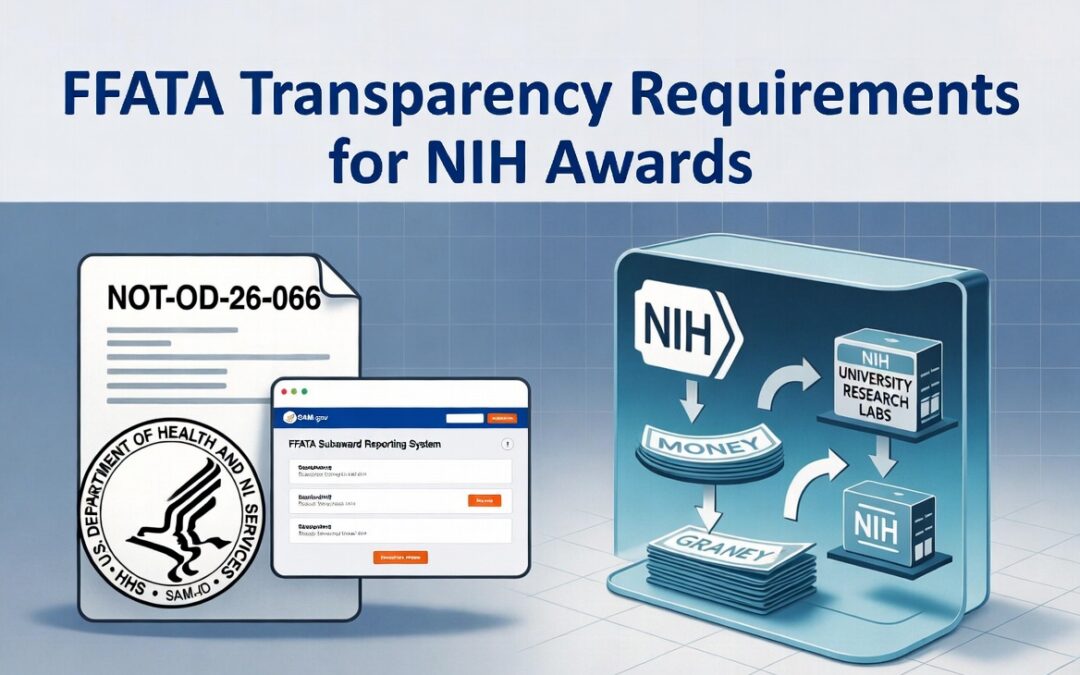
NIH issued a reminder notice (NOT-OD-26-066) on April 10, 2026, titled “Applicability of Transparency Act Subaward Reporting Requirements." This notice, addressed to the extramural research community, reiterated the requirements established in the Federal Funding Accountability and Transparency Act (FFATA) (Public Law 109-282, as amended) for subaward and executive compensation reporting. Further, the notice highlighted that all NIH awards issued on or after October 1, 2010, are subject to the requirement.
NIH further clarified that several older projects (pre-October 2010) must comply with the requirement, despite language in their Notice of Award (NOA) stating that reporting was not required. The requirement applies to older awards because the NIH Grants Policy Statement (GPS) language overrides the NOA language.
NIH GPS Section 4.1.8 is incorporated by reference as a standard term and condition of every NIH Award, and in 2 CFR Part 170, Appendix A provides the details. Let’s look at those requirements.
Subaward Reporting Requirements
Who reports?
All pass-through entities (primes), including nonprofits, for-profits, universities, and other organizations with grants or cooperative agreements, must report information in FSRS related to first-tier subawards, subcontracts, or consortium agreements where obligated funds equal or exceed $30,000, either initially or through subsequent modifications.
Subrecipients do not report directly into the FSRS system. Subrecipients provide information to the prime who makes the report.
When do you report?
Primes must submit subaward information in FSRS by the end of the month following the obligation of funds. For example, a subaward obligation is made on May 15. It must be reported by June 30.)
Where to report?
Reports are submitted via the Federal Funding Accountability and Transparency Act Subaward Reporting System (FSRS). [Note: 2 CFR Part 170, Appendix A still directs you to the old website www.fsrs.gov. As of March 2025, the correct site is www.Sam.gov/fsrs. Hotlinks are provided above.]
What must be reported?
The good news is that existing agency data pre-populates a substantial portion of your reports. However, the primes are responsible for reviewing and confirming the information and providing details of the award amount, etc.
Reports cover data elements for both the pass-through entity and the first-tier subrecipient (regardless of award type). SAM/FSRS will prepopulate existing agency data for much of the report; recipients confirm accuracy and add any missing information.
The data becomes publicly available on USAspending.gov.
Executive Compensation Reporting Requirements
Who must report?
Primes (and subs) that meet all the following criteria (verified in SAM registration profile for the preceding fiscal year) must comply with the executive compensation reporting requirements. Once again, the prime reports for all entities that meet the reporting criteria.
- Annual gross revenue received from Federal grants, subawards, contracts, and subcontracts exceeds 80% or more of total annual gross revenues; and
- Annual gross revenue received from those Federal sources is $25,000,000 or more; and
- Gross income from all sources totaled $300,000 or more; and
Note: For those of you worried about public access to executive compensation information, per Appendix A to Part 170:
“The public does not have access to information about the compensation of the executives through periodic reports filed under section 13(a) or 15(d) of the Securities Exchange Act of 1934 (15 U.S.C. 78m(a), 78o(d)) or section 6104 of the Internal Revenue Code of 1986 after receiving this subaward. (To determine if the public has access to the compensation information, see the U.S. Security and Exchange Commission total compensation filings at http://www.sec.gov/answers/execomp.htm.)”
[Note: The correct name for SEC is the U.S. Securities and Exchange Commission. Appendix A improperly identifies it as U.S. Security and Exchange Commission.] ;opom;
What is reported?
Primes must report the names and total compensation paid in the preceding completed fiscal year for the organization’s five most highly compensated officers/executives. "Total compensation" includes base salary, bonuses, stock options, incentive pay, pension changes, etc. (full definition in the award term).
If a prime recipient meets the criteria, then they report relevant data in their SAM profile. They then report information on first-tier subrecipients (again, those that meet the criteria) in the subaward report.
When to report?
Primes must report their information by the end of the month following the month in which the award is made, and annually thereafter (via a SAM registration update).
Subrecipient information included in the subaward report must be submitted by the end of the month following the subaward obligation.
Where to report?
Executive compensation information is reported in SAM.gov. The prime reports its own data as part of registration updates and the subrecipient information in the subaward report.
Other Things to Know
NIH provides reporting requirement exemptions and special cases accommodations. For instance, certain small awards (< $30,000 total), awards to individuals, or entities with very low gross income may be exempt from some or all requirements. Check 2 CFR 170 and your specific award terms for details.
Responsibility
NIH provides the award data to USAspending.gov.
Recipient organizations are responsible for complying with reporting requirements and ensuring the accuracy of reports.
Mandated Transparency
NIH implemented mandatory transparency rules for NIH awards in 2010. NOT-OD-26-066 is simply a reminder to the research community to ensure ongoing compliance. Primes and recipients should exercise additional care with any legacy awards that contain conflicting NOA language. If you have a specific NIH award or subaward in question, check your Notice of Award and contact your NIH Grants Management Officer or OPERA for clarification.
