A Crucial Document for Federal Contracting
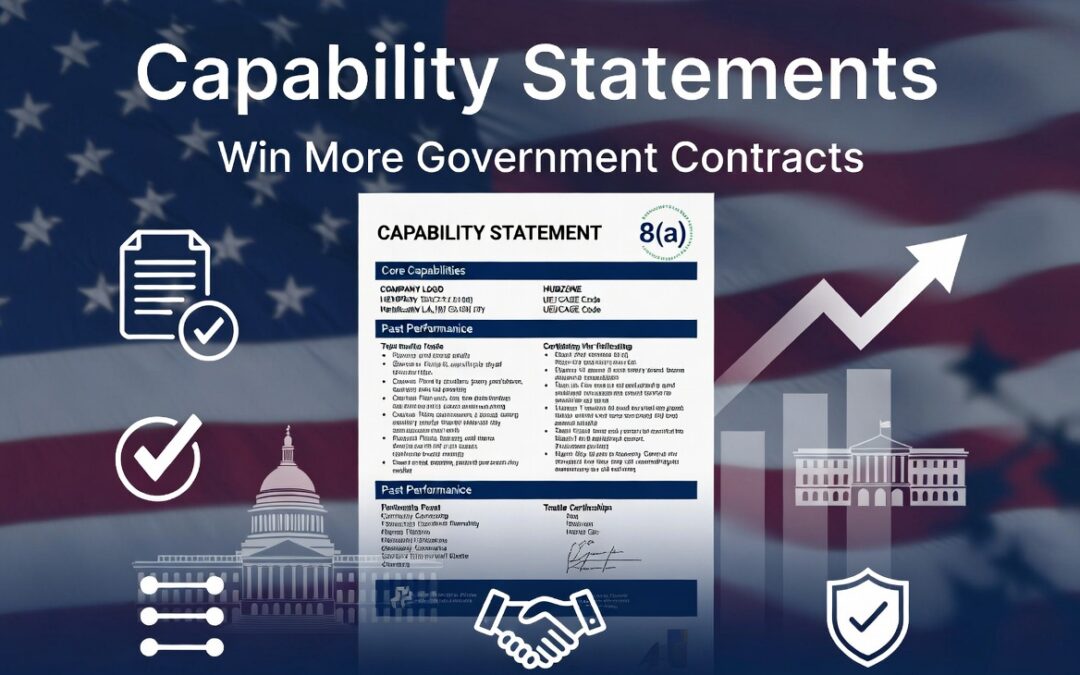
A capability statement is your business’s resume. It is a one-page marketing document that provides the critical information about:
- Who you are.
- What you do.
- Your experience or past performance.
- Reasons why you are the right vendor for the project or agency needs.
The capability statement (“cap statement”) is a snapshot that contracting officers, acquisition staff, prime contractors, and others can use to qualify or disqualify you from the opportunity.
Cap Statements versus Formal Proposals
So, a cap statement is not:
- A formal proposal, or
- A lengthy capabilities brochure.
Instead, it is (or should be) a finely honed, targeted sales tool to enable your business to:
- Get noticed in initial market research seeking qualified prospects (e.g., via SAM.gov / Dynamic Small Business Search – DSBS)
- Receive Requests for Information (RFI)
- Get meetings
- Qualify as a subcontractor
- Stand out in responses to solicitations.
Just like a resume, your cap statement needs to be professional, easy to read, and concise. They should also contain keywords tailored to your contract type objectives.
Why Capability Statements Matter
Like a resume, the capability statement is used to screen candidates. So, federal, state, and local buyers use capability statements as part of their early market research to rapidly identify qualified vendors. The right capability statement signals you are “procurement ready.” That readiness signal can position you to win set-aside opportunities, especially if you hold small-business certifications (8(a), HUBZone, SDVOSB, WOSB, etc.). The cap statement is one of the core marketing assets for federal contractors, together with your SAM.gov profile, website, and online presence (LinkedIn).
While there isn’t an official government-wide template for cap statements (yet), here are some key elements.
Organization and Layout
Your capability statement is one page! It can be front and back, but a clean single front page is easier for acquisition personnel. The single page should be easy to scan, use bullet points and white space, and be saved as a PDF. Some sources recommend presenting content in a Z-pattern layout. (A Z-pattern enables the reader to go from top-left to top-right, then diagonally to the bottom-left to bottom-right.)
Document Header
The header can be considered the most important section. It contains:
- Company name, logo, and your value proposition (and tagline).
- The document title is “Capability Statement.”
- Your identifying information:
- Unique Entity ID (UEI)
- CAGE Code (include a hyperlink to SAM/DSBS when possible)
- Certifications (Socioeconomic) with logos.
- Contract vehicle (GSA, MAS, GWAC, IDIQ, MAC, BPA, etc.)
Company Overview
The company overview is your opportunity to hook the reader. It is your 2–3 sentence “About Us.” Be focused and brief, make a powerful summary that includes:
- years in business,
- what you do,
- mission
- value proposition
- ownership
- CEO/top executive if it is relevant.
Core Capabilities / Competencies
It is tempting to make a massive list of all things you could do. This isn’t the place for that. You want a focused list of what you do best. At most, you want 4–6 focused bullets consisting of specific use keywords that match how agencies describe their needs (include relevant NAICS and PSC codes).
The government isn’t looking for a “jack of all trades”; it is seeking expertise in specific areas. Examples include:
- “NIST-compliant cybersecurity solutions including risk assessments and cloud migration for federal agencies.”
- “FDA 21 CFR Part 820 and ISO 13485-compliant design, development, and manufacturing of Class II and III biomedical devices that include diagnostic equipment and implantable sensors for VA and DoD healthcare programs.”
- “Drone-enabled logistics and inspection services, delivering cost-effective aerial solutions with encrypted communications and integration into federal command-and-control systems.”
- “Advanced vaccine platform technologies (mRNA, viral vector, recombinant) with proven technology transfer and surge manufacturing capacity for government biodefense and public health initiatives.”
Quantified Past Performance
Contracting officers seeking qualified companies look for past performance on similar scope projects. They look for quantifiable results (e.g., “Completed $10M DoW contract; reduced system downtime by 25%.”). You should include client names (government or commercial) and briefly describe the outcomes. If you have not performed on government contracts, you can include commercial or subcontractor experience.
Differentiation Factors (Differentiators)
What sets you apart? Agencies are looking at or for company/team expertise and experience, patents, proprietary technology, specialized clearances, geographic advantage, and employee certifications. This is where you answer the question, “Why choose us?”
Company Data / Footer
- Primary NAICS codes (top 3–5 only)
- Certifications and small-business status
- Contract vehicles participated in
- Major clients served
- Relevant staff clearances, insurance, bonding, etc. (if relevant)
- Primary point of contact and full contact details
How to Write a Winning Capability Statement
The first step to an effective cap statement is to create a general version. Once you have that broad perspective document, the next step is to customize it for specific agencies and/or solicitations. The customization should focus on matching your experience and capabilities to the agency’s specific needs.
Next, ensure your document is concise, specific, and structured for ease of reading. Some characteristics of winning capability statements include:
- Bulleted lists,
- Tables, and
- Branding.
Once you have the substance of the document, use editing tools to catch typos, grammar, and spelling errors. Also, ask someone who hasn’t worked on the document or a trusted advisor to proofread for grammar and clarity. (AI tools are great, but they aren’t human! So they don’t necessarily perceive content in the same way.)
Keywords and Updates
Remember, keywords are crucial to being seen in online searches (SAM and DSBS). So, take the time to identify the right ones for your target agencies and opportunities. One approach is to use language that appears in agency forecasts or solicitations.
“We’re the best, take our word for it,” isn’t going to win your projects. You need to quantify your metrics and past performance. I shouldn’t have to say this, but I’m going to: Your metrics need to be genuine results you’ve achieved in commercial or government projects.
Your business changes. So, you need to keep your cap statement current. You should review and update it at least quarterly, as needed.
Common Mistakes to Avoid
If you want to win, avoid these mistakes:
- Lack of focus (too many NAICS codes, etc.)
- Vague language that lacks keywords and quantified results.
- Too much information.
- Cluttered layout or design.
- Outdated information.
- Missing/incomplete key business information.
- False information.
- Irrelevant information that does not pertain to the opportunity or agency.
- Oversized PDF file. (Make sure the file is sized to attach to an email, submit, etc.).
- Expired or incomplete SAM.gov/DSBS registrations or profile.
Real World Example
Several years ago, I was hired by a company that went into government contracting for administrative services, call centers, etc. The company was about 10 years old at the time and had been highly profitable through private-sector projects. The owner/CEO thought that success would automatically translate to government contracting. To an extent, he was correct. The company was highly successful in securing contracts set aside for small, veteran-owned, and minority-owned businesses.
Grow Revenues and Profits
Where the success didn’t translate was into profitability. The company did not take into consideration labor rates and other price/cost information that differ for government contracts. The established billing rates for the service contract were drastically understated relative to the actual costs incurred. While the company doubled in size due to the number of contracts won and the revenues, profits plunged! Unfortunately, the company didn’t realize what was happening because its accounting and other systems weren't designed to track contracts/projects.
Robust Business Systems
The company implemented a new accounting system, a robust cost-estimating and bid-development system, and other significant operational and financial changes. Once everything was in place and the unprofitable projects were completed, the company pursued new opportunities that were properly priced/costed. Today, the company continues to grow revenues and profits.
Conclusion
Government acquisition contracts are great opportunities for businesses of all sizes. However, they require that your business be “procurement-ready,” meaning it is professional, capable, and credible. It also means your business systems must meet government contractor standards. If you are just getting started, you may want to get started as a subcontractor rather than a prime. As a subcontractor, you begin building your business credibility and testing your ability to deliver, navigate compliance requirements, and secure time to upgrade existing systems or implement new ones that support government contracting.
